The AI boom is shaping what homes in the Bay Area market look like
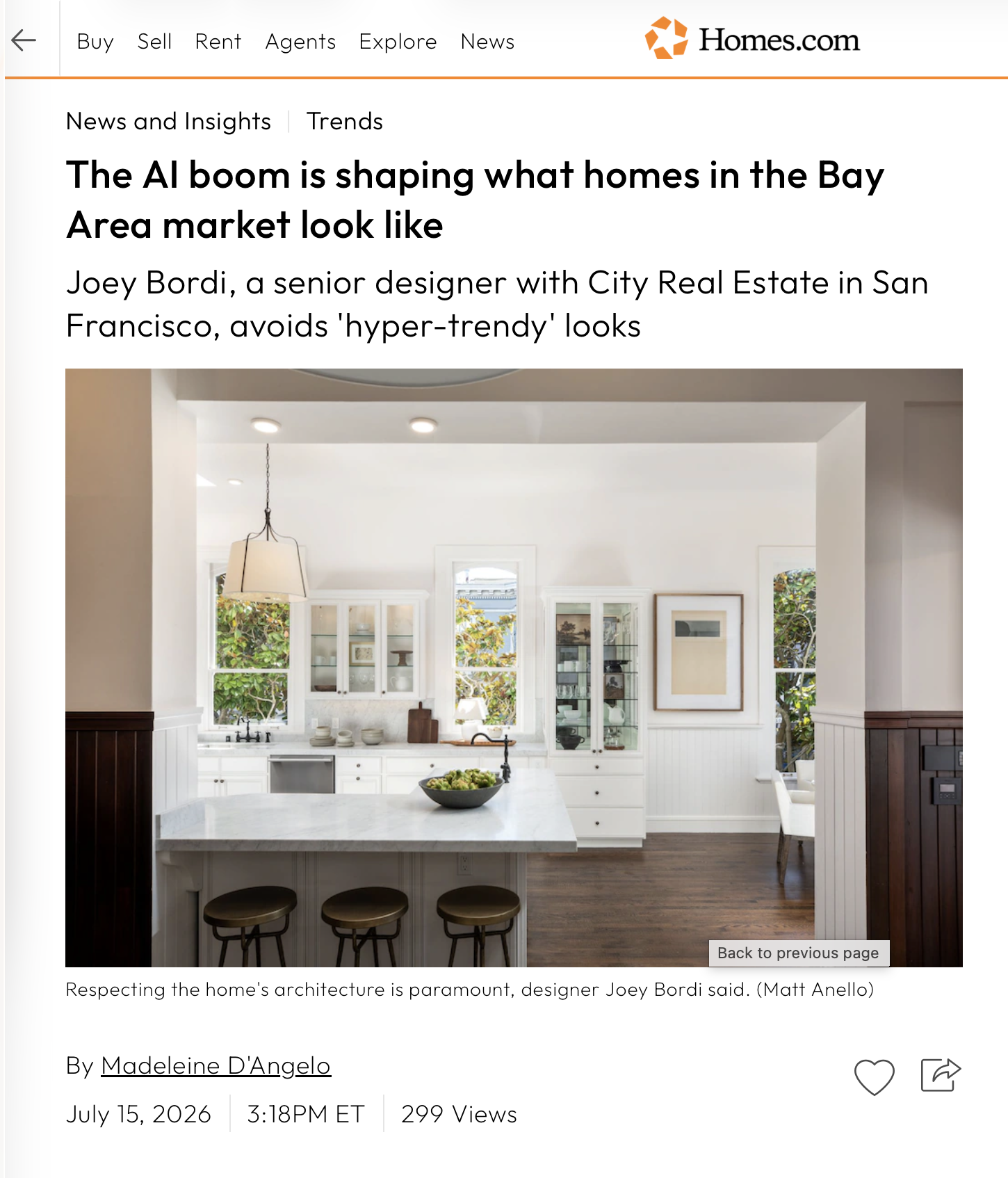
Joey Bordi, a senior designer with City Real Estate in San Francisco, avoids 'hyper-trendy' looks
Key takeaways
City Real Estate designer Joey Bordi says homes are moving faster in the San Francisco Bay Area as tech wealth flows into the market, increasing the pace of listing preparation, staging and pre-sale improvements.
In a city known for limited lot sizes, features such as large yards, pool potential and well-defined rooms are attracting attention, while oversized open-concept layouts have fallen out of favor.
Bordi avoids cookie-cutter design trends, tailoring staging to each property's architecture and neighborhood.
Over the past few months, Joey Bordi’s work life has been fast-paced.
As a senior designer and project manager for City Real Estate in San Francisco, Bordi ensures that the listings that land with the brokerage can “sing,” he said, even if that time on the market is shrinking as theartificial intelligence boom pulses through the city.
“The sheer speed and volume of homes that we’re prepping and getting ready has definitely increased with the demand of buyers and influx of funds in the city,” he said. Even so, the Bay Area native focuses on design and pre-renovation work (the tweaks that a brokerage can complete that fall short of a full renovation) as the AI landscape alters everything from sales timeframes to the aesthetic preferences of buyers. Broadly, he said, this encompasses everything from interior and exterior painting to kitchen updates, as well as coordinating with a staging company to help a property realize its market potential.
“I think a common denominator in San Francisco right now is things being on the market for a short amount of time,” he said. “Oftentimes, we'll stage a house, be on the market for a very small amount of time and then have to de-stage it because it sells so quickly.”
Related content:
Cookie-cutter homes don't work in the Bay Area
Before launching his career in real estate, Bordi studied visual communication at the Fashion Institute of Design & Merchandising in Los Angeles, and after graduation, he landed at a luxury property development company called The Boxwood House. One wing of the company built and staged rentals in San Francisco, while the other developed, built and staged manufactured homes from the ground up.
Stay InformedGet the latest residential real estate news, trends and expert insights delivered weekly to your inbox.
The position gave Bordi experience with two disparate forms of real estate, he said. “I was in these multimillion-dollar homes at the beginning of the week, and then, toward the tail end of the week, I was in these very entry-level manufactured homes, but I brought the same attention to detail and design to both worlds.”
From there, Bordi hopped to something completely unexpected: event design for the then-emerging online retailer Poshmark.
Joey Bordi (City Real Estate)
While the work was “totally out of my wheelhouse,” Bordi threw himself into planning, staying at the company for nearly five years until he moved back into the world of real estate as a designer for a staging and interiors company. Bordi had always wanted to get back into real estate, he said. The industry fully allowed him to satisfy the curiosity he’d had about idealized homes and model residential spaces since childhood, when he would beg his parents to take him into the model homes they’d drive by on summer trips to Lake Tahoe.
“I was so interested in seeing these model homes that companies or designers would put together for this aspirational kind of living,” Bordi said. “It just fascinated me.”
After a few years in staging, Bordi met City Real Estate founder David Cohen and joined the firm full time, throwing himself into the process of improving listings before they officially hit the market.
Lately, Bordi has been making sure the homes avoid any “hyper-trendy” or “cookie-cutter” aesthetics, he said, bringing in individually selected lights and other fixtures. While he needs to move fast and has a roster of favorite pieces (such as Visual Comfort’s Morrison chandelier, which “has a nod to history, but also has an air of contemporary,” he said), his spaces can’t show it.
Bordi is partial to the Visual Comfort Morrison chandelier. (Matt Anello)
The “just hurry up and get it on” mentality does not work well in San Francisco,” Bordi said.
The following interview has been edited and condensed.
Does your experience working in events shape your design approach at all?
There are a lot of overlaps with hosting, events and how you present a house. When I walk into the home for a project, some of my first thoughts are: Would I entertain in this house? How would I want to live in this house?
When I was doing events, I would always want there to be this kind of feeling of community and comfort in the space. With real estate, it might be aspirational, but you want it to be comfortable and inviting, too. So, the throughline between events and design is making sure there is cohesion and comfort in both spaces.
We’ve talked about Bay Area property values shooting up and homes selling fast amid a boom of buyers working in artificial intelligence. What aesthetic trends are you seeing? What is the greatest common denominator that appeals to these buyers?
I think the most desirable trend right now is simply scale and lot size. It's interesting because San Francisco isn’t known for spectacular weather. We have so many beautiful things, but our weather tends to be on the chillier side.
Still, I've heard now from several people looking for homes that either have a pool or can accommodate a pool. We have land scarcity here in San Francisco, and most people don’t even have a yard, so if a home can allow for a swimming pool, that just speaks to the size and the scale of the home.